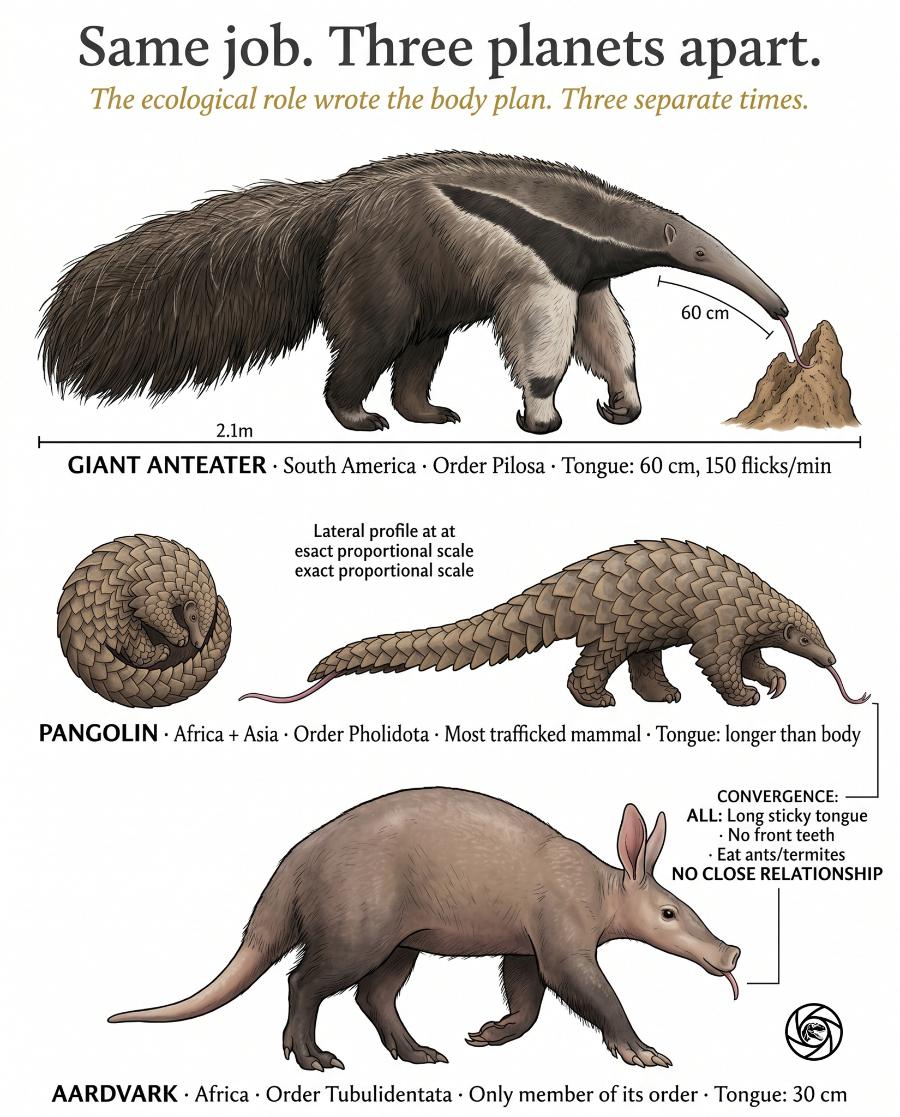
Великолепный пример конвергентной эволюции (не считая второго языка на жопке у панголина🤣, это чатжпт шутит):
Экологическая ниша мирмекофага (питающегося муравьями или термитами) сделала абсолютно неродственных животных на разных континентах (Америка, Азия, Африка) максимально похожими.
Раз где-то есть муравьи, то рано или поздно найдется и их поедатель, чего добру пропадать. И он будет выглядеть именно так, просто потому, что при такой диете и способе добывать хлеб свой насущный, это - самая удобная форма тела и набор привычек.
Раньше ученые по ошибке относили схожих животных в родственные отряды, семейства и даже роды, но генетика все расставила по своим местам. Просто по всему миру, даже не приходясь друг другу родней, все строители носят каски, космонавты - скафандры, а стюардессы - фирменные улыбки и дурацкие шейные платочки. Не носившие не выжили, ну или не удержались на этой работе
Обратный этому процесс называется дивергенцией или расхождением - когда два родственных вида на одной территории решают не конкурировать друг с другом, каждый начинает заниматься своими делами, например, один питаться семенами, второй мясом, а третий - фруктами, и быстро (в эволюционном смысле) меняют под это свои тела и образ жизни. Соответственно, с появлением секвенирования геномов, биологи выругались нецензурно и начали пихать в одни клады кашалотов с бегемотами, а моржей с медведями.
The Giant Anteater, the Pangolin, and the Aardvark All Eat Ants and Termites. All Have Long Sticky Tongues and No Functional Teeth. They Evolved on Three Different Continents. They Are Not Related. The Job Made the Animal.
Same job. Three different continents. Three completely separate lineages. The same design.
Myrmecophage — an animal that eats ants and/or termites as its primary food source — is not a taxonomic category. It is an ecological role. And evolution has filled it at least three times with unrelated animals that ended up looking oddly similar:
GIANT ANTEATER — Myrmecophaga tridactyla (South America): Up to 2.1 metres long, 40 kg. The most extreme myrmecophage — the skull is a long tube, the tongue can extend 60 cm beyond the snout tip, can flick 150 times per minute, produces 2 kg of sticky saliva per day. Toothless. Claws: 10 cm curved blades for tearing open termite mounds. Order Pilosa — not related to any other continent's myrmecophage.
PANGOLIN — Manis spp. (Africa, Asia): Already featured for trafficking (post 340) and defence (post 517). Here as ecological comparison: keratin-scaled, tongue can extend beyond body length, toothless, eats exclusively ants/termites. 8 species across two continents. Order Pholidota — its closest living relative: Carnivora (lions, dogs, cats).
AARDVARK — Orycteropus afer (Africa): Pig-sized, nocturnal, a different body plan from the Pangolin despite sharing the continent. The tongue: 30 cm, sticky, extensible. Teeth: present (modified peg-like teeth in the cheeks only, no incisors or canines). The ears: long rabbit-like. Order Tubulidentata — its own entirely separate order with no close living relatives.
Three animals. Three continents. Three separate evolutionary paths. All ending at a long sticky tongue, reduced dentition, and a diet of social insects.
When three unrelated lineages all converge on long sticky tongues and no front teeth — and all eat ants — does that make "eating ants" an ecological niche that has only one optimal body plan?
Comments (2)
Этого товарища забыли
О как, а я думал, что aardvark это муравьед, а он трубкозуб.